I got tired of feeling the lie.
You are behind. That is what every planner I owned ended up saying to me, and for years I believed it.

Why my paper planner never worked
I tried a paper planner every single year. The trouble was always the same. If I laid out the whole year in August, I was never going to keep to it perfectly, because life happens. Then I felt behind. I felt bad that we were not where we were supposed to be, which is silly when you think about it, because being able to move things is the whole reason I love homeschooling. We do not have to keep the school system's calendar. That is the point.
So I gave up on planning the year and started doing a week or two at a time. That quieted the guilt and broke something else. I could never see the whole year at a glance. I could not tell whether we were on track to finish when I wanted to finish.
Every year around Christmas I would sit down and count lessons and count days, working out whether we would make it by May. The counting brought the feeling straight back. It was exhausting.
Why a digital homeschool planner has to do more than paper
The online options I looked at did not help either. Too complicated, too much work, or honestly just paper on a computer. I was still the one who had to move everything.
That is the one thing a digital homeschool planner can do that a paper one never will. It can move the work for you.
What an online homeschool planner should do when you miss a week
Here is the whole idea of Margin. You put in your children, your books, how many lessons each one has, and the days you teach. Margin lays out the entire year before your first Monday.
Then somebody gets sick, or the car breaks down, or it is simply a bad week. You tell Margin what happened and it redoes the rest of the year. Not one lesson. The year. You pick how to absorb it:
- Spread it out so the missed work is shared across the weeks ahead and you barely notice it.
- Double up on the days that can take it, and keep your end date.
- Push the year out farther, and finish a little later.
Whichever you pick, the calendar is right again in a second or two. You did not fall behind. The plan changed.
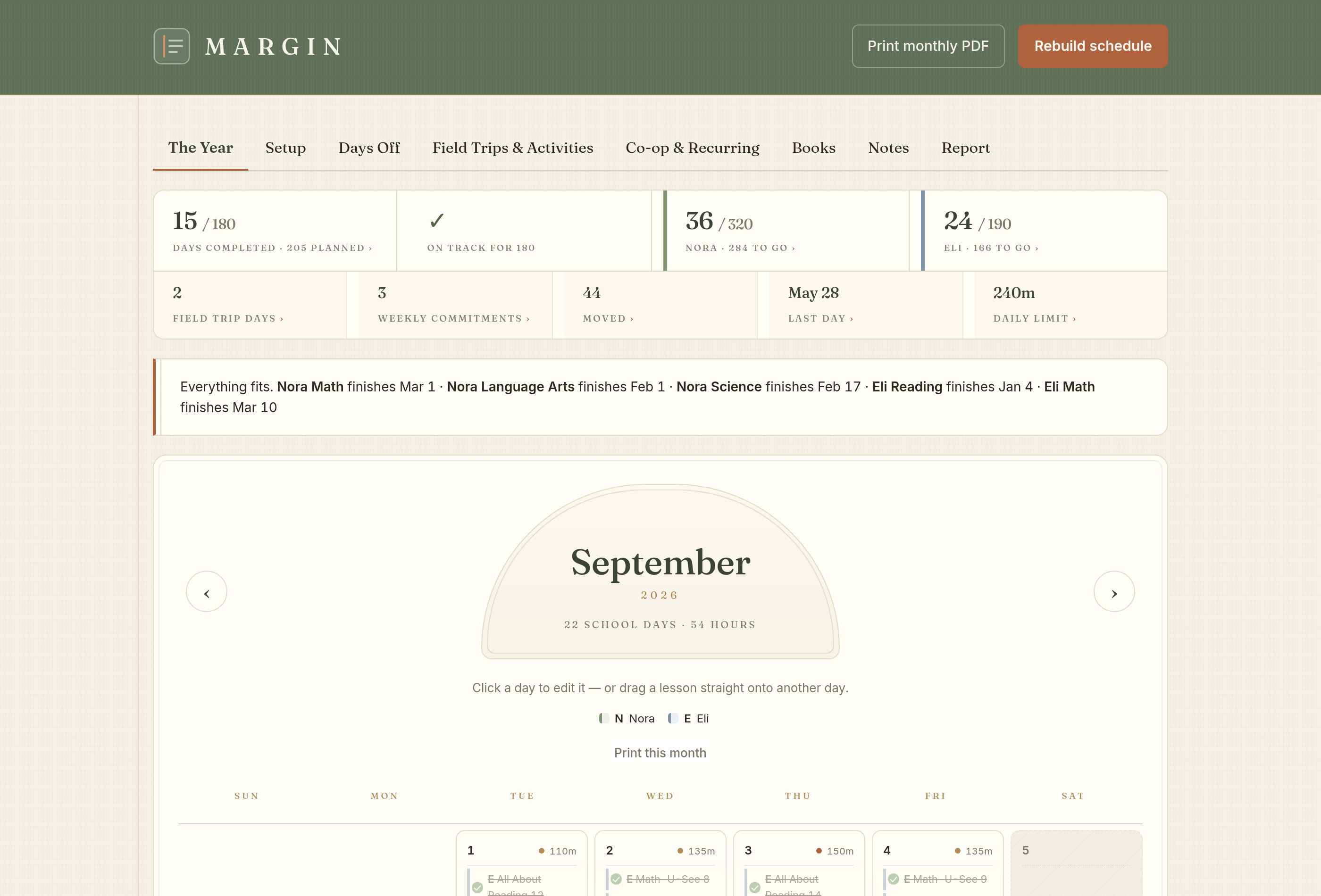
The record your state or association asks for
Margin keeps the count while you teach: school days, hours, and what each child actually finished. When somebody asks for it, you print it. You do not spend a weekend building a binder out of memory.
What it costs
$8 a month, or $80 a year, for your whole family however many children you have. Fourteen days free to try it. If you ever stop paying you keep your records, and you can still open, print and export every year you planned.
What is not in it
No AI. Your children's schedule is never sent to one, never stored by one, and never used to train one. That was decided before a line of code was written and it is not going to change.
On your phone
Margin works in a phone browser today, and the iPhone app is on its way. When it lands you will get the day's work on your home screen, and library books will remind you the day before they go back.
Start here
Go to marginplanner.com and set up your year. It takes about fifteen minutes with your books in front of you, and you can change any of it afterward.
What I did not expect
This started out as a planning tool. What I have realized while we built it is that it was quietly solving a stress I did not know I was carrying. I have teared up over it more than once, which is not what I expected to say about a calendar.
I love homeschooling because of how flexible I can be. And yet I kept finding myself feeling guilty for being behind, for not being where I was supposed to be, according to a piece of paper. Which is just so silly.
So if you are reading this in the middle of a week that has already gone sideways: you are not behind. The plan changed. Those are different things, and it took me years to learn it.