
Paper and screen, honestly

Paper or a digital homeschool planner?
Paper first.

I bought a paper planner every August for years. Here is what it did better, and the one thing it could never do.

What paper does better.

All three of these are true, and I am not going to pretend otherwise.

It is cheaperA good planner is twenty or thirty dollars, once. Margin is $8 a month. Over a year that is a real difference and you should count it.
It is prettierNothing on a screen feels like a well-made paper spread in September. The paper, the ribbon, your own handwriting. I still miss it.
A pen is fasterWhile the plan is working, a pen beats a screen every time. No sign-in, no battery, and nothing else on the device trying to get your attention.
A craft table covered in markers, watercolors and painted stones
The part nobody puts in the ad

Paper is wonderful right up until the plan changes.

If I laid out the whole year in August, I never kept to it. Life happened. Then I felt behind, which is silly, because being able to move things is the reason I love homeschooling in the first place.

So I tried planning a week at a time instead. That quieted the guilt and broke something else. I could not see the year. I could not tell whether we would finish by May.

Every Christmas I sat down and counted lessons and counted days to find out. It was exhausting.
The whole point

A digital homeschool planner can move the work for you.

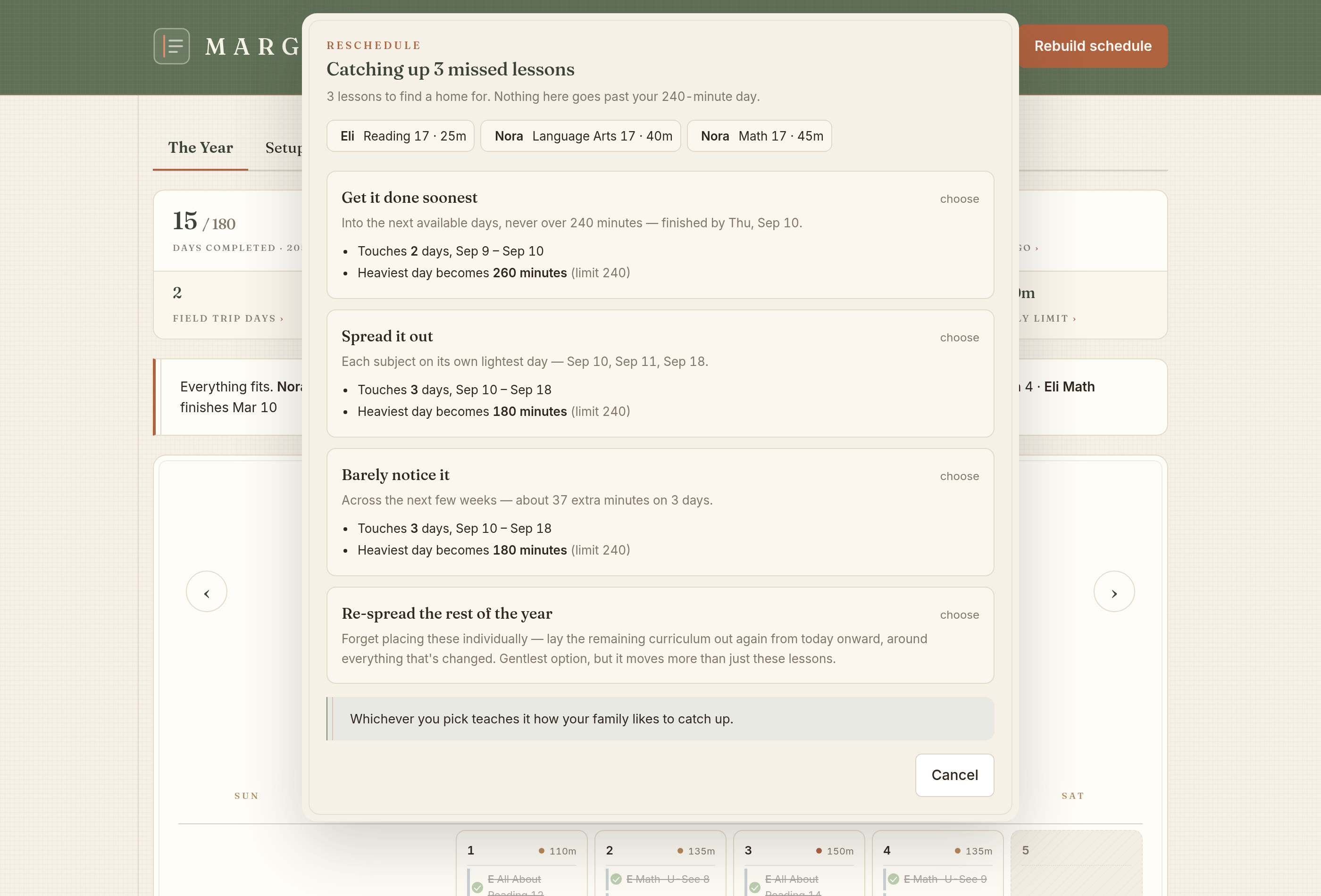
That is the difference. Not the search box and not the backups. Miss a week on paper and you are the one rewriting every subject to the end of the year. Tell Margin what happened and it redoes the rest of the year. Not one lesson. The year.

  • Get it done soonest puts the work into the earliest days that still have the hours for it
  • Spread it out gives each subject its own lightest day over the weeks ahead
  • Barely notice it does the same thing across a much longer stretch, and names the extra minutes
  • If none of them fit, it can lay the rest of the year out again or add days and tell you how many

Each one is priced in minutes before you choose. The calendar is right again in a second or two.

See how the rest works
Three ways to catch up after a missed week, each priced in minutes
You pick. It re-plans.

Every other planner has to be rewritten. Margin rewrites itself.

That is the whole reason this one exists.

The smaller things a screen just does better.

None of these would move me on their own. Together they add up.

The records are already doneSchool days, hours and subjects are counted while you teach. When your association asks, you print it instead of building a binder out of memory.
A day at the aquarium countsField trips, co-op days and sick days each go in as what they were, and each one lands in the right column of your record.
It cannot be left at Grandma'sA paper planner exists in one place at a time. This one is on the laptop and the phone, and a second parent can have their own login.

What you give up.

We would rather tell you straight, so you can decide before you pay us anything.

A subscription, not a purchase$8 a month keeps running. A paper planner is bought once and then it is yours. If you stop paying you keep your records and can still open, print and export every year, but the planning stops.
A screen in the roomYou are holding a device instead of a book. Some families would rather not, and that is a real reason.
An evening of setupYour children, your books, the lesson counts and the days you teach. About fifteen minutes with the books in front of you, which is longer than opening a new planner to page one.
No high school transcriptIf you keep grades there is a report card, and it is not a transcript. There is no grade point average, no credits and no state scale. If that is the document you need this year, a notebook and a spreadsheet will serve you better than we will.
It is January and the planner is half empty

Can you switch in the middle of the year?

Yes, and January is when most of us finally do it. Nothing about Margin expects you to be starting in August.

You tell it where each book really is, not where the plan said it would be. Lesson 42 of math, chapter nine of the read-aloud, wherever you actually are. It lays the rest of each book out from today to your last day, around your co-op and your activities and the days you have already taken off.

What you type in

  • Who you are teaching, and which days you teach
  • Each book, and the lesson that child is on today
  • How long a day each child can really give you
  • Your co-op, your activities and your days off

What you get back

  • Every lesson that is left, on a real date, through your last day
  • An answer to whether you finish by May
  • Anything that will not fit, said now instead of in April
  • The days you already taught, once you have put them in

The planner you already bought is not wasted. Plenty of mothers keep writing in one because they like writing in one, and let Margin do the counting underneath. You can print the week out of Margin with a box beside every line and carry that into Monday.

The part paper leaves to you

Counting your days in April, by hand.

That is what those Christmas evenings were. My planner held every bit of it and never once added any of it up for me.

Margin counts while you teach. A day counts as school if it has bookwork on it, or a co-op, an activity or a field trip, and it is not a day off. The co-op Tuesday counts. So does the field trip, and the Saturday we worked, and the library reading program in July. Margin keeps the days you planned and the days somebody actually turned up as two separate numbers, so you can show either one.

When our association asks for a record, mine is already written. You print the whole year or any month of it, everyone together or one child on their own, with the daily register or without it. It carries attendance, the subjects and assignments, the books they read, co-op and activities, field trips, music and art at home, sports, summer learning, life studies, and your holidays and breaks. Each child starts a fresh sheet of paper.

Questions before you leave paper.

Is a paper homeschool planner or a digital one better?

It depends on whether your year moves. Paper is cheaper and prettier, and a pen is faster than a screen while the plan is still working. A digital planner earns its keep the week the plan stops working, because it moves the rest of the work for you instead of leaving you to rewrite every subject by hand.

What does a digital homeschool planner do that paper cannot?

It plans the rest of the year again. You tell Margin what happened and pick how to take it, and each way tells you what it costs in minutes first. It also counts your school days while you teach, so you are not adding them up by hand in April.

What does a digital homeschool planner cost?

Margin is $8 a month, or $80 a year, for your whole family however many children you have. The first fourteen days are free with everything in them, and the trial asks for a card. A paper planner is twenty or thirty dollars once. Over a year that is a real difference and you should count it.

Can I start in the middle of the school year?

Yes. You tell Margin the lesson each child is on today and it lays the rest out from here to your last day, around your co-op and your activities and your days off. Most of us who switch do it in January, not in August.

Can I still write on paper?

Yes. Margin prints a plan to write on, for the whole family or for one child. A month gives you the month on a page, then a page for each week, then the events and the books. Every line has a box beside it.

What happens the week everything falls apart?

You tell Margin what you missed and it gives you three ways to fit it back in, and each one says how long your longest day gets. If none of them fit it can lay the rest of the year out again, or add days at the end and tell you how many. On paper that same week is me at the kitchen table rewriting every subject to June.

Will it tell me whether we will finish by May?

Yes. Every lesson in every book sits on a real date through your last day, so anything that will not fit is said now instead of in April. That is the question I used to spend a whole evening counting to answer.

Does it count my co-op days as school days?

Yes. A day counts as school if it has bookwork on it, or a co-op, an activity or a field trip, and it is not a day off. A Saturday you worked and a summer reading program count too.

What do I hand my accountability association?

You print the record, for the whole year or any month of it, everyone together or one child on their own. It carries attendance, the subjects and assignments, the books they read, co-op and activities, field trips, music and art at home, sports, summer learning, life studies, and your holidays and breaks. Print the daily register with it or leave it as a summary.

What happens to my plans if I stop paying?

You keep your records. You can still open, print and export every year you planned in Margin. The planning is what stops. You can also save your whole year to a file at any time and load it back in later.

Is it worth $8 a month when a planner is $30 once?

That is a fair question and you should count it honestly. Over a year Margin costs more than a paper planner does. What the money buys is the part paper never did for me, which is moving the work when the week changes and counting the days while I teach. If your year rarely moves and you love a pen, paper is a fine answer and I am not going to pretend otherwise.

Does it print a high school transcript?

No. If you keep grades there is a report card, which is one page for each child with the subjects down the side and the grade beside each one. It is not a transcript. There is no grade point average, no credits and no state scale.

Will my children’s information be sold or used to train an AI?

No. Your children’s schedule is not a product. It is never sold, never shared, and never handed to an AI to learn from. There are no ads and no trackers in Margin. You can read the whole of what we believe on the values page.

Start your free trial

More answers are on the questions page.

What it costs.

$8
a month for your whole family, however many children you have. Or $80 a year, which gives you two months free.
14-day free trial with everything included. And if you ever stop paying, you keep your records. You can still open, print and export every year you planned in Margin.
Start your free trial

You are not behind. The plan changed.

Try it free for 14 days. It runs in your browser, so there is an online homeschool planner side to it too, and a homeschool planning app on both app stores.

Questions · What we believe · Notes · Help · Contact · Privacy · Terms · Affiliate

Online homeschool planner · Digital homeschool planner · Homeschool planning app

Margin™ © 2026 Margin Planner LLC